What Does AI Customer Support Really Cost? Replies, Credits or Resolutions

Short answer: AI customer support is billed in four main ways: per AI reply (PepoChat, $39 a month for 1,000), per message credit (Chatbase, $40 a month for 700), per resolution (Intercom Fin at $0.99, Zendesk at $1.50 to $2.00) or per AI conversation (Tidio Lyro, $210 a month for 300). For a small business with 300 to 5,000 conversations a month, our worked bills put PepoChat at $39 to $499, the lowest and most predictable published price of the tools compared.
- Reply and credit pricing charge for AI work; resolution pricing charges for AI success, so that bill grows as the bot improves.
- Seats, branding removal, inbox plan gates and overage rates often cost more than the headline price.
- At 1,500 conversations a month the same workload costs $149 on PepoChat, $190 on Chatbase (1-credit model), $1,008 on Intercom and $1,977 on Zendesk.
- The largest cost is usually the human time spent on conversations the AI hands off, not the AI itself.
This guide is for small business owners pricing an AI agent for their website who keep meeting units that do not line up: replies, credits, outcomes, resolutions and seats. You get a definition of each unit, a table of vendor prices and three worked monthly bills you can check line by line.
How it was put together: we read each vendor's pricing page, help center and billing docs on 6 November 2026, confirmed the numbers on the live pricing pages that day, and built every bill from published prices only. Where a price is not published, the table says so, and the assumptions sit in their own table so you can swap in your own figures.
All prices are in US dollars on monthly billing, checked 6 November 2026; yearly billing lowers most of them. For the wider market, PepoChat's AI customer support pricing index compares 30 tools.
AI customer support billing units explained: replies, credits, resolutions and conversations
Per AI reply (PepoChat)
An AI reply is one answer the AI agent writes in a visitor conversation. Team messages, the greeting and test chats are free. Free includes 100 replies a month, Starter ($39) 1,000, Growth ($149) 5,000 and Scale ($499) 17,000, and replies past a paid allowance cost $39 per 1,000 ($0.039 each). Every feature is on every plan except new-lead emails and phone numbers for inbound calls. A started minute of a voice call counts as 6 replies. The full table is on PepoChat's pricing page.
Message credits (Chatbase)
A message credit is Chatbase's unit of AI usage, and a reply costs 1 to 5 credits depending on the model you pick: Chatbase's docs list 1 for its recommended models, 2 for mid-tier models such as Claude 5.5 Sonnet, 4 for GPT-5.5 and 5 for Claude 5.5 Opus. When an Action runs, the agent makes a second model request, doubling that reply's cost. Hobby ($40) includes 700 credits, Basic ($150) 4,000 and Business ($500) 15,000, and Chatbase's pricing page sells extra credits at $40 per 1,000. Plan credits do not roll over.
Per resolution or outcome (Intercom Fin, Zendesk, Gorgias)
A resolution, which Intercom calls an outcome, is a conversation the AI is judged to have closed without a person. Intercom's pricing page charges $0.99 per Fin outcome, at most one per conversation, counted when the customer confirms the fix, when Fin completes a procedure (handoffs included) or when the customer asks for nothing more. Fin's help article on resolutions adds that 24 hours of silence after Fin's last answer counts as an assumed resolution. PepoChat's breakdown of how Fin pricing adds up goes further.
Zendesk's pricing page includes 5 automated resolutions per agent a month on Suite Team (10 on Suite Professional), then charges $1.50 each on a commitment or $2.00 pay-as-you-go; only resolutions that pass an AI check are billed. Gorgias, a helpdesk for Shopify stores, bills an automated interaction (a request fully resolved without a human agent) on top of a per-ticket fee. Each AI Agent bundle on Gorgias's pricing page includes 30 to 530 interactions, then $1.50 each.
Per AI conversation (Tidio Lyro)
A Lyro conversation is any Tidio conversation with at least one reply from its AI agent, however many follow. Tidio's pricing page sells Lyro as its own monthly quota: 50 for $39, 300 for $210 and 1,000 for $700, with more on a custom plan. Tidio separately meters billable conversations, the ones a human agent replies to, so a chat Lyro answers and then hands over counts on both meters.
Seats and add-ons
A seat is a paid login for one teammate, and an add-on is a separately priced extra such as branding removal. Intercom ($39 per seat on Essential) and Zendesk ($69 per agent on Suite Team, its first plan with live chat) charge seats on top of AI usage. PepoChat includes 3 members on Starter, 10 on Growth and 20 on Scale, with extra seats at $15 a month; Gorgias includes 3 seats on Starter and 500 from Basic; Tidio allows up to 10 agents on self-serve plans.
| Tool | Billing unit | Price per unit past the allowance | Cheapest plan with a team inbox | When the allowance runs out |
|---|---|---|---|---|
| PepoChat | AI reply | $0.039 ($39 per 1,000) | Free: 100 replies; Starter $39: 1,000 replies | Free: new chats go to the team inbox; paid plans keep answering and bill overage |
| Chatbase | Message credit (1 to 5 per reply) | $0.04 ($40 per 1,000 credits) | Basic $150: 4,000 credits (Hobby has 700 but no Helpdesk inbox) | Agent shows "currently unavailable" unless auto recharge is on |
| Intercom | Fin outcome | $0.99 (no allowance) | Essential $39 per seat | Every outcome is billed |
| Zendesk | Automated resolution | $1.50 committed, $2.00 pay-as-you-go | Suite Team $69 per agent: 5 resolutions per agent | Overage on by default; can be set to pause the AI agent |
| Gorgias | Ticket plus automated interaction | $0.40 or $0.36 per ticket; $1.50 per interaction | Starter $40 with AI Agent: 50 tickets, 30 interactions | Overage billed per ticket and per interaction |
| Tidio | Lyro conversation plus human conversation | Next quota step (for example 300 Lyro for $210) | Free: 50 human conversations a month, 50 Lyro conversations once | Free Lyro quota never renews; monthly plans step up at 95% unless you switch that off |
Prices and features from each vendor's own pages, checked 6 November 2026.
Three small-business support profiles: the assumptions
Units that do not convert into each other can only be compared against a workload. These three profiles are planning assumptions, not statistics, so replace them with numbers from your own chat and email history.
| Assumption | Profile A: small business | Profile B: growing business | Profile C: busy business |
|---|---|---|---|
| Customer conversations a month | 300 | 1,500 | 5,000 |
| Average AI replies per conversation | 3 | 3 | 3 |
| AI replies a month | 900 | 4,500 | 15,000 |
| Share the AI resolves without a person | 60% | 60% | 60% |
| Conversations resolved by the AI | 180 | 900 | 3,000 |
| Conversations handed to a person | 120 | 600 | 2,000 |
| Agent seats needed | 1 | 3 | 5 |
| Billing | Monthly | Monthly | Monthly |
Three AI replies is a short exchange: a question, a follow-up and an answer. Your real resolution rate depends on your knowledge base and what customers ask.
Worked monthly bills: what each AI support tool costs at 300, 1,500 and 5,000 conversations

Each cell is the cheapest published plan that covers the profile, with top-ups, overage and seats. Chatbase appears twice because the model changes the credit count.
| Tool (what is billed) | Profile A: 300 conversations, 1 seat | Profile B: 1,500 conversations, 3 seats | Profile C: 5,000 conversations, 5 seats |
|---|---|---|---|
| PepoChat (AI replies) | $39 (Starter) | $149 (Growth) | $499 (Scale) |
| Chatbase, 1-credit model (credits) | $150 (Basic) | $190 (Basic + 1,000 credits) | $500 (Business) |
| Chatbase, 2-credit model (credits) | $150 (Basic) | $350 (Basic + 5,000 credits) | $1,100 (Business + 15,000 credits) |
| Tidio (Lyro conversations + human conversations) | $269 (Growth 250 + Lyro 300) | $129 + Lyro custom quote | $349 + Lyro custom quote |
| Intercom Essential + Fin (seats + outcomes) | $217.20 | $1,008 | $3,165 |
| Gorgias with AI Agent, Shopify only (tickets + interactions) | $315 (Basic) | $1,615 (Pro) | $5,135 (Advanced) |
| Zendesk Suite Team (seats + resolutions, pay-as-you-go) | $419 | $1,977 | $6,295 |
Prices and features from each vendor's own pages, checked 6 November 2026.
How the Profile B numbers were calculated
PepoChat: 1,500 conversations times 3 replies is 4,500 AI replies, inside Growth's 5,000, so the bill is $149. Starter would be $39 plus 3,500 extra replies at $0.039 ($136.50), or $175.50, so Growth is cheaper. Profile A's 900 replies fit Starter ($39) and Profile C's 15,000 fit Scale ($499).
Intercom: three Essential seats at $39 are $117. The AI resolves 60% of 1,500 conversations: 900 outcomes at $0.99, or $891. Together, $1,008 a month.
Zendesk: three Suite Team agents at $69 are $207 and include 15 resolutions. The other 885 at $2.00 pay-as-you-go add $1,770, for $1,977, or $1,534.50 at the $1.50 committed rate. Because only verified resolutions are billed, a real bill could be lower.
Chatbase: on a 1-credit model, 4,500 replies use 4,500 credits. Basic includes 4,000 and 3 members, so one $40 top-up brings it to $190. A 2-credit model needs 9,000 credits: Basic plus five top-ups is $350. Hobby is cheaper, but the Helpdesk inbox that handoffs need starts on Basic.
Gorgias: Pro with AI Agent costs $550 and covers 2,000 tickets and 190 interactions; the other 710 at $1.50 add $1,065, for $1,615. Its AI Agent needs a connected Shopify store.
Tidio: 600 handoffs fit the $129 Growth step, but 1,500 Lyro conversations is above the largest published quota, so the AI part needs a quote. Profile A is $59 for Growth's 250-conversation step plus $210 for 300 Lyro conversations: $269.
What changes the bills most
Two levers pull in opposite directions. If the AI resolves 80% instead of 60%, resolution-priced bills rise: Intercom's Profile B goes from $1,008 to $1,305 (1,200 outcomes at $0.99 plus $117 in seats), while PepoChat's stays at $149 because the reply count has not changed. If conversations run to five AI replies instead of three, reply-priced bills rise instead: PepoChat's Profile B becomes $246.50 (Growth plus 2,500 extra replies) and Profile C $811 (Scale plus 8,000 extra), still below every resolution-priced bill in the table.
Hidden costs of AI customer support beyond the headline price
Seats and plan gates on the inbox
Chatbase's Helpdesk inbox and helpdesk integrations start on Basic at $150. Zendesk's $25 Support Team plan has no messaging or live chat, so the comparison uses Suite Team. Intercom puts round-robin assignment, multiple team inboxes and its workflow builder on Advanced at $99 per seat. PepoChat includes its team inbox on every plan, Free included, with assignment, tags, internal notes and macros.
Branding removal
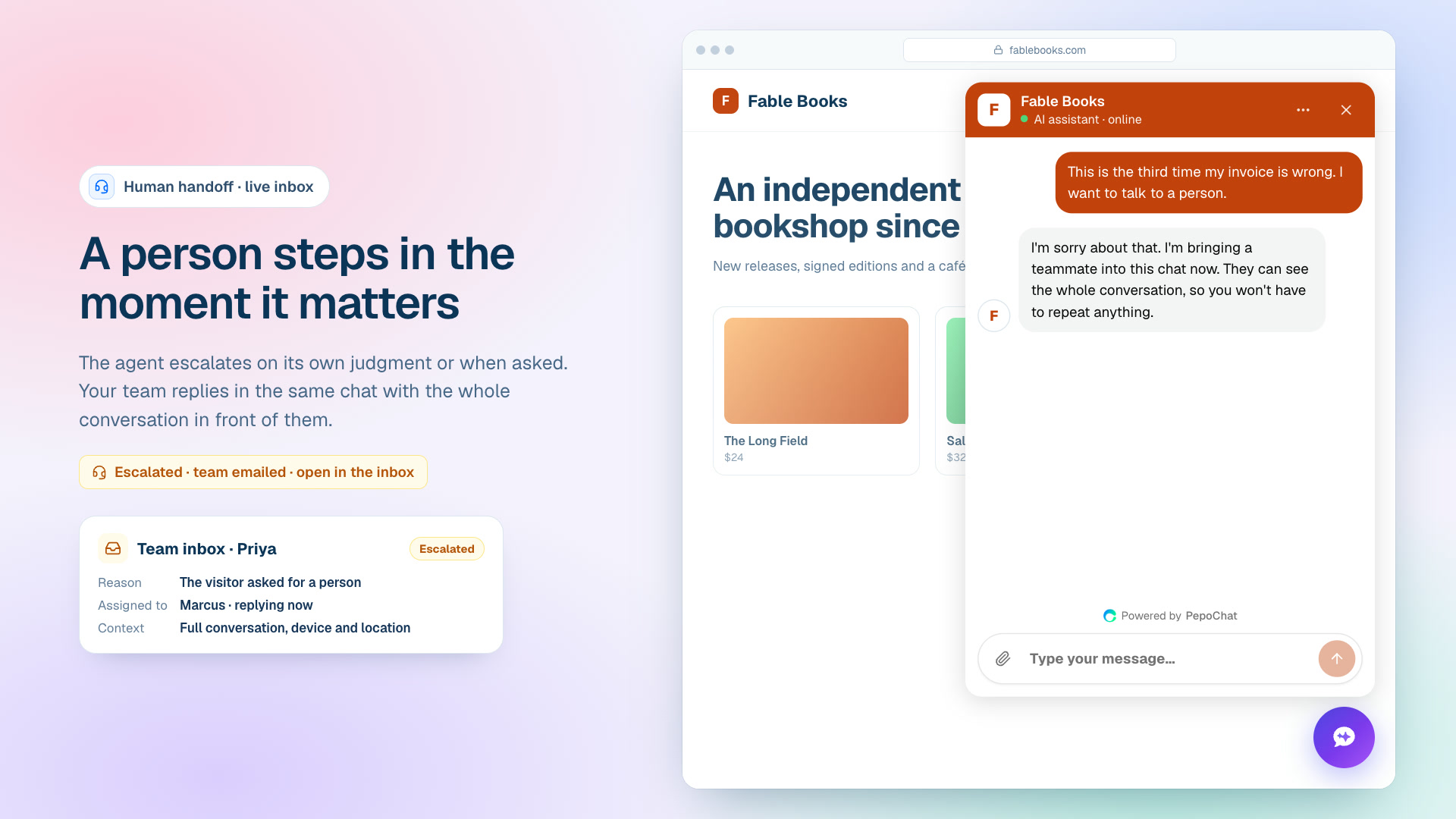
Chatbase charges $99 a month to remove its branding. Tidio sells a no-branding add-on for $20 a month on Growth, not on Free or Starter. Zendesk's self-serve plans do not include widget unbranding. PepoChat is stricter: the small "Powered by PepoChat" line shows on every plan and nothing removes it, so if you need a white-label widget, PepoChat is the wrong tool.
Extra agents and workspaces
Each Chatbase plan includes one AI agent; extras are $25 a month. PepoChat allows one Free workspace per account; more need a paid plan.
Overage rates and allowances running out
When Chatbase credits run out, the widget tells visitors the agent is unavailable until you top up or turn on auto recharge. Tidio's 50 free Lyro conversations never renew, and monthly plans step up automatically at 95% of a quota unless you switch that off. Zendesk can pause the AI agent at the allowance. On PepoChat's Free plan, using the 100th reply sends new conversations to your team inbox with a friendly message until the 1st; on paid plans the agent keeps answering at $39 per 1,000 extra replies. PepoChat has no self-serve spend cap, so in a busy month watch the usage meters on the billing page.
Assumed and verified resolutions
Intercom counts 24 hours of silence after Fin's last answer as resolved, even if the customer gave up. Zendesk bills only resolutions its AI check verifies. Gorgias charges a ticket plus an interaction when its AI resolves a conversation, and only the ticket if an agent replies within 72 hours.
The biggest cost is the human time behind every handoff
In all three profiles, 40% of conversations end with a person. Assume 6 minutes of a person's time per handoff for reading the history, replying and following up: that is 12 hours a month for Profile A, 60 for Profile B and 200 for Profile C. Without the AI answering first, the same assumption puts Profile B at 150 hours, close to a full-time role.

For scale, the WoodBows pricing page lists a 40 Hours Monthly plan at $899/mo, an 80 Hours Monthly plan at $1299/mo and a Full-Time Plan (160 hours of task work) at $1999/mo on monthly billing, with lower rates on longer terms. Next to Profile B's 60 hours, a $149 AI subscription is the small line.
So handoff quality matters more than a few dollars of AI pricing. When PepoChat's agent finds nothing relevant, or the visitor asks for a person, the team gets an email alert with the last messages and a link, and a teammate replies in the same chat under their own name; outside business hours it can collect the visitor's email for a follow-up. That person can be on your team or a WoodBows customer support assistant. Our guide to AI chatbots with human handoff compares how each vendor does it.
When PepoChat is not the cheapest or the right fit
Chatbase at 5,000 conversations is a tie. On a 1-credit model, Chatbase Business costs $500 against PepoChat Scale's $499. For that money Chatbase adds WhatsApp, Instagram, Messenger, email and phone channels and a model menu, while PepoChat Scale includes 20 members to Chatbase's 5. Our Chatbase vs PepoChat comparison covers the rest.
Resolution pricing can win when the AI resolves little. At 3 replies per conversation, PepoChat's overage is about $0.12 a conversation, and Fin at $0.99 per outcome averages less only below about a 12% resolution rate. With 10-reply threads, PepoChat's overage is $0.39 a conversation, and Fin is lower below about 39%. Per-reply pricing also charges for conversations that end in a handoff; resolution pricing does not.
Channels and actions PepoChat lacks. PepoChat covers the website widget, a hosted chat page, widget voice calls and inbound phone. WhatsApp and Messenger are in limited rollout, and there is no Instagram, SMS or email channel. No PepoChat action moves money, while Gorgias's AI Agent can cancel, edit and refund Shopify orders. Chatbase and Tidio both state SOC 2 Type II on their own sites; PepoChat makes no SOC 2 claim.
Startup programs. Intercom's Early Stage program (up to $10M in funding, fewer than 15 employees, not already a customer) starts at $65 a month in year one with 300 Fin outcomes a month, which can undercut a flat plan that year.
How to choose the right AI support pricing model
- If you get fewer than about 30 conversations a month, PepoChat Free (100 replies) costs nothing.
- If you want a fixed monthly number, choose per-reply pricing and check where the next tier pays off: on PepoChat, Growth beats Starter plus overage from about 3,800 replies a month, and Scale beats Growth from about 14,000.
- If you are pricing Chatbase, pick the model before you budget: a 2-credit model doubles the credit burn.
- If you already pay for Intercom or Zendesk seats and the AI resolves a small share of long conversations, per-resolution pricing may cost less at the margin.
- If you run a Shopify store and want the AI to cancel or refund orders, Gorgias can; budget for its two meters.
- If customers mostly reach you on WhatsApp, Instagram or email, pick a tool with those channels generally available, such as Chatbase, Intercom, Zendesk, Tidio or Gorgias.
- If handoffs are frequent, budget human hours alongside the software, and compare the shortlist in our roundup of the best AI customer support chatbots for small businesses.
PepoChat's guide to what an AI support chatbot costs in 2026 works through more budget scenarios.
What to do next
Pull last month's numbers (conversations, replies per conversation, and how many needed a person) and rerun the tables with your own figures. If PepoChat fits, create a free PepoChat workspace with no credit card and watch the reply meter for a month before picking a plan. If the handoff hours are the bigger number, book a free consultation with WoodBows about a support assistant to take those conversations.
Frequently asked questions
How much does AI customer support cost for a small business?
On prices checked 6 November 2026, 300 conversations a month cost $39 on PepoChat Starter, $150 on Chatbase Basic, $217.20 on Intercom with one seat and $419 on Zendesk Suite Team with one agent. At 1,500 conversations the range runs from $149 on PepoChat Growth to $1,977 on Zendesk, assuming 3 AI replies per conversation and 60% resolved by the AI.
What is the difference between per-reply and per-resolution pricing?
Per-reply pricing charges for each answer the AI writes, whether or not the conversation ends well, so the bill follows your traffic. Per-resolution pricing charges only when the AI is judged to have solved the issue, so failed conversations cost nothing but the bill grows as the AI improves. Per-reply is easier to predict; per-resolution ties cost to results.
How many Chatbase message credits does one reply use?
It depends on the model. Chatbase's docs list 1 credit per reply for recommended models such as Auto, GPT-6 Luna and Claude 5.5 Haiku, 2 for mid-tier models, 4 for GPT-5.5 and 5 for Claude 5.5 Opus. When an Action runs, the agent makes a second model request, doubling that reply's credits. Extra credits cost $40 per 1,000.
Does Intercom charge for Fin conversations handed to a human?
Not for ordinary escalations: Fin's help center says that when a customer asks for a human or shows frustration and Fin hands over, you are not billed. Intercom does charge $0.99 when a Procedure hands the conversation to your team as instructed, and when the customer goes quiet for 24 hours after Fin's last answer, an assumed resolution.
Can you remove the "Powered by PepoChat" line?
No. The small "Powered by PepoChat" line shows on the widget on every plan, Scale included, and no add-on removes it. If a fully unbranded widget is a requirement, look at Chatbase, which sells branding removal for $99 a month, or Tidio, which offers it as a $20-a-month add-on on Growth and includes it on Plus and Premium.
What happens when you go over your PepoChat reply allowance?
On Starter, Growth and Scale the agent keeps answering, and extra replies are billed at $39 per 1,000 on the next invoice. There is no self-serve spend cap, so check the usage meters on the billing page in busy months. On the Free plan, once 100 replies are used, new conversations go to your team inbox with a friendly message until the 1st.